

How Does Humidity Affect Hardwood?
Extreme humidity will impact the wood’s integrity as hardwood flooring is a natural product. If the air is very humid, the planks of flooring will start to absorb some of the moisture and will consequently expand. If there are low levels of humidity, the planks of flooring will start to dry out and shrink. However, minimal fluctuations in the humidity will not impact your hardwood, as it is natural for it to contract and expand with variations in the weather.
The Expansion Gap
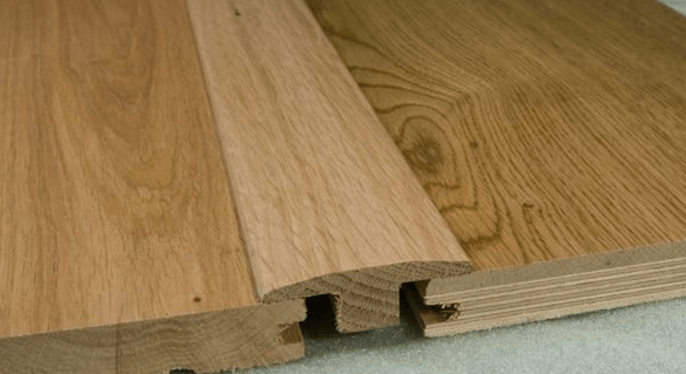
An expansion gap is an essential gap that must be left around the edge of the room when fitting hardwood flooring. The gap should be around the whole perimeter of the room wherever the flooring may be against fixed objects, such as doorways, radiator pipes, fireplaces, and walls. The space between planks will allow for natural expansion and contraction into the gap without causing any distortion or damage to your hardwood flooring itself. If no expansion gap has been left, when a floor naturally expands, it will have nowhere to go and will raise up and deform the wood planks.
What Size Expansion Gap Do You Need?
An expansion gap of between 12mm to 15mm is required for standard sized areas. To ensure the adequate sized expansion gap is left, flooring spacers can be used during installation. They are removed once the installation process is complete.
The Flooring Spacers
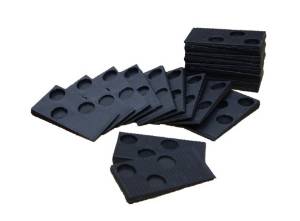 For larger rooms with a linear width of 10 meters or more, there should be small gaps left in between flooring boards throughout the room, in addition to an expansion gap around the perimeter of the area. As a general rule of thumb, the gaps must be left between every fifth plank of hardwood flooring. Note that this can only work if the flooring is being nailed, glued, or screwed directly to the subfloor. Flooring spacers are used as helpers to leave the expansion gaps required for spacious rooms. The gaps allow for a uniform expansion across the whole space because the hardwood planks expand more in width than length.
If significant changes in humidity affecting your hardwood floor is a concern for you, then we recommend installing engineered hardwood flooring, as it is more resilient to these changes in temperature and moisture. Even though this type of hardwood floor can resist changes in temperature and humidity better than solid wood floors, they also need an expansion gap to allow for small movements.
Contact T&G Flooring for more information about hardwood flooring in Colorado. Install your wood floors with the best in Denver.