
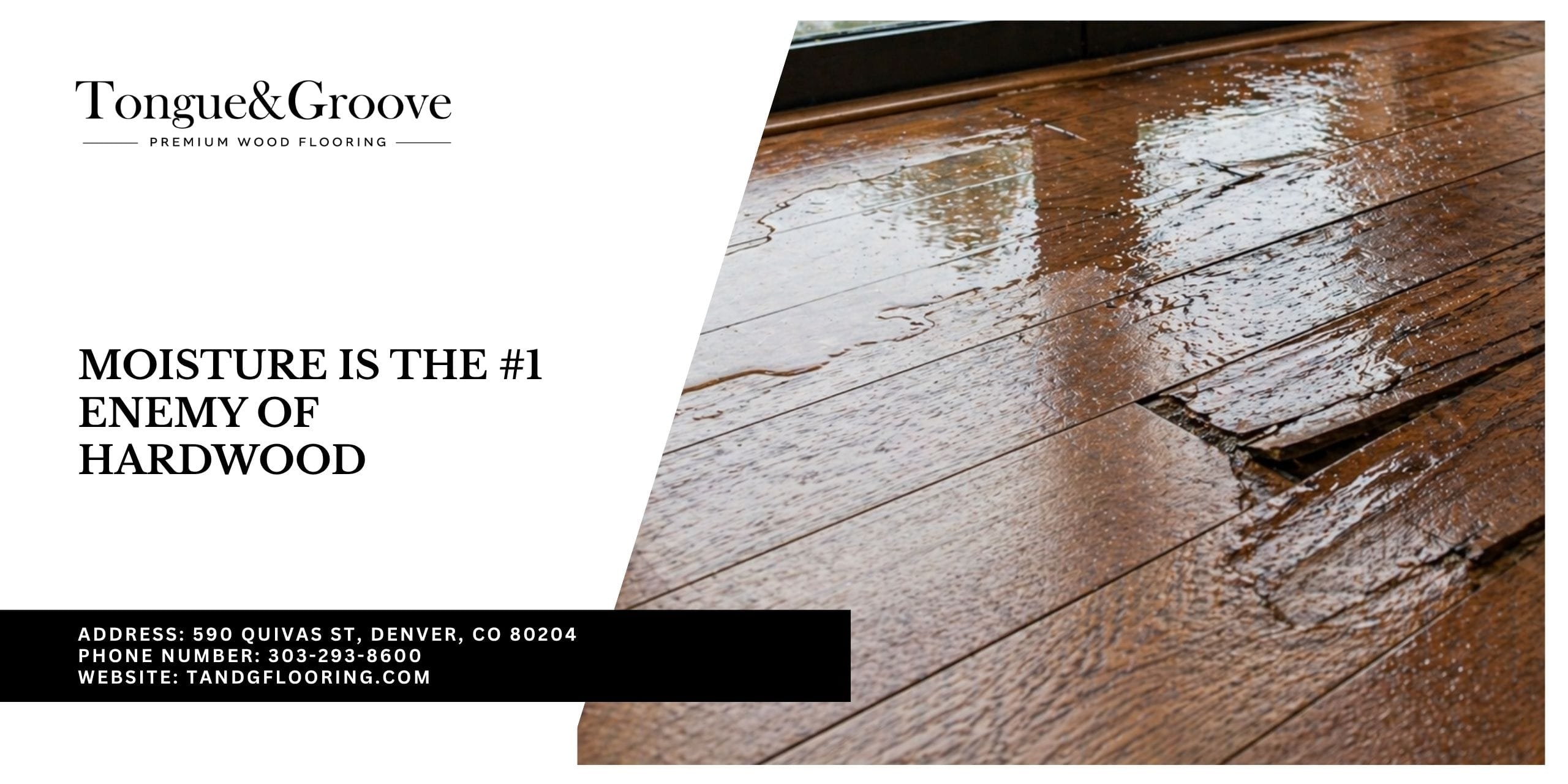
Hardwood floors can last a lifetime as long as they’re protected from moisture.
What’s the number one enemy of hardwood? It’s not pets, high heels or heavy furniture, it’s moisture.
Why? It warps boards, causes gapping, leads to cupping and crowning and can render a beautiful floor structurally unsound. Most homeowners don’t pick up on moisture problems until the damage is done, but understanding how moisture affects hardwood flooring and what to do about it is a whole different story.
At Tongue & Groove, we understand the importance of moisture management. It’s part of every conversation we have with homeowners and custom builders across Denver. Colorado’s climate presents moisture challenges and getting it wrong has consequences. Let’s get into what you need to know!
Table of Contents
ToggleHow Does Moisture Affect Hardwood Floors?
Wood is a living material. Even after milling, drying and finishing, it still responds to the moisture in the air around it, expanding when humidity rises and contracting when it drops.
That movement is normal, but the issue comes when the swings are too extreme or happen too fast.
Too much moisture makes wood fibers swell. Boards expand against each other, creating pressure that has nowhere to go, causing cupping, which is where the edges of a board rise higher than the center or crowning, where the center rises above the edges. In more severe cases, boards can buckle entirely.
The National Wood Flooring Association recommends maintaining indoor relative humidity between 35% and 55% year-round to minimize movement and protect your floors.
What Humidity Level is Too Low for Hardwood Floors?
Generally, hardwood flooring manufacturers write their warranties assuming a home falls within the 35-55% relative humidity range, which is reasonable in other parts of the country.
In Colorado, this isn’t the case.
Denver winters can reach 18-20% relative humidity levels. Sometimes, they can be even lower. At those levels, even well-installed, well-finished hardwood floors are vulnerable to measurable shrinkage and gapping. Unfortunately, this isn’t a defect, it’s physics.
That’s what Tongue & Groove’s ClimateSure line is built for, this curated line of hardwood products have manufacturer warranties that hold at relative humidity as low as 20%. Every product is chosen with Colorado’s climate in mind. For Denver homeowners, this isn’t a preference, it’s a form of protection.
What are the Signs of Moisture Damage in Hardwood Floors?
What do you have to watch out for? These are the common signs of moisture damage:
- Gapping: Visible spaces between boards are normal during the dry winter months and minor seasonal gapping in Colorado. Persistent or wide gaps can indicate a chronic humidity problem.
- Cupping: Board edges become higher than the center, creating a concave surface. It’s usually a sign of excess moisture below the floor or a humidity imbalance between the top and bottom of the board.
- Crowning: This is when the center of the board goes higher than the edges. It usually follows cupping that was sanded before the moisture issue was resolved.
- Buckling: Boards lift entirely off the subfloor. When this problem shows up, it’s usually a result of flooding, plumbing leaks or extreme humidity swings.
- Staining or Discoloration: Dark spots or streaks on the wood surface usually mean water has penetrated the finish.
If any of these signs are showing up, you should call in a professional wood flooring contractor to identify and address the source of moisture. This prevents the need to refinish or replace the floor. Refinishing an unresolved moisture problem only leads to delays.
How Do You Protect Hardwood Floors from Moisture?
Preventing moisture from damaging your hardwood floors in the first place is the way to. Check out some of our tips:
- Control Indoor Humidity Year-Round: A whole-home humidifier is a great option for Denver homeowners. It helps maintain consistent relative humidity through dry winters without the need for constant manual adjustment.
- Acclimate Your Flooring Before Installation: Hardwood needs time to adjust to the temperature and humidity of the space before installation. Get your products delivered ahead of time to prevent post-installation problems.
- Choose the Right Product for Your Climate: Some hardwood products aren’t made for Colorado’s conditions. ClimateSure products from Tongue & Groove are since they work all the way down to 20% relative humidity, standard products don’t offer this.
- Address Subfloor Moisture Before Installation: When moisture rises from a concrete subfloor or crawl, it often leads to cupping and buckling. A proper moisture barrier and subfloor assessment go a long way.
- Clean Up Spills Right Away: Surface moisture from spills, wet mopping or steam cleaning will damage the finish and wreak havoc on the wood over time. Damp mop only and wipe spills when they happen.
Planning a hardwood flooring installation or wood refinishing project in Denver? If you are, you want to properly manage moisture. Contact Tongue & Groove or visit our showroom so we can assess your space and walk you through our product lines today.
Does Moisture Affect Engineered Hardwood Differently Than Solid Hardwood?
Yes, that’s why engineered hardwood flooring in Denver is better for moisture-prone environments.
Solid hardwood planks are a single piece of timber. The grain runs in one direction, is more reactive to humidity changes and more vulnerable to cupping and warping as conditions change.
Engineered hardwood consists of multiple layers, including a real wood veneer top. Below is cross-ply construction that’s more dimensionally stable and responds to humidity changes better and with less movement than its counterpart.
In Colorado, engineered hardwood makes more sense for below-grade applications and where humidity is difficult to maintain. Just remember to speak with an expert to choose the right product for your space.
The Verdict on Moisture and Hardwood Floors
Moisture is the biggest threat to the long-term performance of hardwood floors. At Tongue & Groove, we understand that. Winter humidity can drop well below the range most products are designed for and moisture management is essential, not optional.
Worried about installing hardwood in a moisture-prone area? Visit our Denver showroom or contact us to make the right choice for your home!